What happens to the body at 50?
Fifty is the decade when hormones, bones, and digestion change all at once. Here is what happens and why it is the best time to take action.

Introduction
The fifties are a period in life when several independent processes coincide.
Hormonal shifts reach their peak. Bone mass begins to decrease more rapidly. Stomach acid production declines, which affects the absorption of several nutrients. Muscle loss accelerates. The immune system changes.
That sounds bleak when written out like that, but the picture is more nuanced. Fifty is also the age when many people have the most knowledge, the best judgment, and the greatest opportunity to actually do something about it. And research is clear that it is not too late for any of these processes.
In this guide, we go through what actually changes at fifty, which nutrients become harder to absorb, and what has the greatest effect.
Menopause and what follows
The average age for menopause in Sweden is around 51.
When estrogen production decreases, significantly more systems are affected than most people realize. Estrogen has receptors in bones, blood vessels, the brain, skin, mucous membranes, and muscle tissue.
The most well-known symptoms are hot flashes and sleep disturbances. Less talked about but just as real are changes in mood, cognition, joint pain, skin elasticity, and body composition.
For men There is no corresponding clear transition. The decline in testosterone continues at its slow pace, about one to two percent per year, which at fifty means a significant decrease from levels in your twenties.
The difference is that women's changes happen quickly and noticeably, while men's happen slowly and are therefore often attributed to stress or aging in general.
Bone mass decreases faster
This is perhaps the most important change to understand at fifty.
The skeleton is continuously remodeled throughout life. Cells break down old bone tissue and others build new. Up until about the age of thirty, building outweighs breakdown; after that, there is roughly a balance, and then the breakdown begins to dominate.
After menopause, the process accelerates sharply. Women can lose a significant portion of their bone mass during the first five to seven years after menopause, because estrogen has a protective effect on the skeleton that suddenly disappears.
Men lose bone mass more slowly but continuously, and osteoporosis in men is significantly more common than general perception suggests.
What counteracts the process is load, i.e., strength training and weight-bearing activity, along with sufficient intake of calcium, vitamin D, and protein.
Stomach acid decreases
A change that receives surprisingly little attention despite major consequences.
Stomach acid production decreases with age in a significant portion of the population. Estimates suggest that about thirty percent of people over sixty have lower stomach acid than normal.
Stomach acid is needed to release several nutrients from food:
Vitamin B12 requires stomach acid to be released from proteins in food. This is the most common cause of B12 deficiency in the elderly.
Iron is absorbed better in an acidic environment.
Calcium requires stomach acid to be dissolved in certain forms.
Zinc and magnesium are also affected.
This means that a person can eat just as well as before but still absorb fewer nutrients. Medications that inhibit stomach acid, for example for heartburn, further amplify this effect.
Muscle loss accelerates
Sarcopenia, the age-related loss of muscle mass and strength, picks up speed during one's fifties and sixties.
Without counteracting exercise, the loss can amount to one to two percent per year, and the loss of strength often happens faster than the loss of mass.
The consequences extend far beyond aesthetics. Muscle mass affects metabolism, blood sugar regulation, balance, fall risk, and functional ability later in life.
Research is unanimous on one point: strength training works at any age. Studies on people in their eighties and nineties have shown significant strength gains after structured training. It is never too late, but it is always easier the earlier you start.
Vitamin D becomes harder to produce
The skin's ability to produce vitamin D from sunlight decreases significantly with age. A seventy-year-old produces significantly less vitamin D than a twenty-year-old with the same sun exposure.
In Sweden, where the skin cannot produce vitamin D from October to March anyway, this becomes a double challenge.
This is why the Nordic Nutrition Recommendations specify a higher intake for people over 75, twenty micrograms per day compared to ten for younger adults.
The immune system changes
The immune system undergoes gradual changes with age, a process sometimes referred to as immunosenescence.
In practical terms, this means that infections may take longer to overcome, the response to vaccinations may weaken, and there is a tendency toward chronic low-grade inflammation.
The latter, sometimes called inflammaging, is an active area of research and has been linked to several age-related conditions.
Factors that have a positive impact include regular physical activity, sufficient sleep, a nutritious diet, and a healthy gut microbiome.
Metabolism: it’s actually starting to change now
The study in Science that showed metabolism is stable from age twenty to sixty also provided insights into what happens thereafter.
From around sixty, it declines by approximately 0.7 percent per year.
At fifty, metabolism is therefore still largely intact. However, it is a reasonable time to prepare for the changes to come, primarily by maintaining muscle mass.
Cognitive: a nuanced picture
At fifty, processing speed has decreased slightly compared to one's twenties. It takes longer to learn new systems, switch between tasks, and perform under time pressure.
At the same time, knowledge, pattern recognition, judgment, and the ability to see the bigger picture are at their peak or still on the rise.
Furthermore, research on cognitive reserve suggests that education, complex work, social networks, and lifelong learning build a buffer that makes the brain more resilient.
The practical advice here: keep challenging your brain with new things, not just what you are already good at.
What matters most now
1. Strength training two to three times a week. The single most important measure for muscles, bones, balance, and metabolism.
2. Sufficient protein intake. The need is higher than the official minimum levels for many in this age group, while appetite often decreases.
3. Check your vitamin D status. Both skin production and dietary intake need to be reviewed.
4. Take hormonal changes seriously. There is now evidence-based treatment available for many of these symptoms, and counseling has advanced significantly.
5. Regular health check-ups. Blood pressure, blood lipids, blood sugar, and relevant blood counts.
6. Load your bones. Weight-bearing activity is the only thing that directly stimulates bone formation.
7. Prioritize sleep. It becomes more fragmented, making routines more important than before.
Nutrition at fifty
Several nutrients become more critical, partly because the need increases and partly because absorption decreases.
Vitamin B12 due to reduced stomach acid. Bioactive forms like methylcobalamin require less conversion in the body.
Vitamin D because the skin's production decreases.
Calcium for the skeleton, especially after menopause.
Protein to counteract muscle loss.
Magnesium which is needed, among other things, to activate vitamin D.
Iron where the situation changes for women after menopause, as the need usually decreases when menstrual blood loss ceases.
Folate and other B vitamins for normal energy metabolism.
When should you seek medical care?
Book an appointment for:
- A more comprehensive health check-up if you haven't had one in several years
- Discussion about menopause symptoms and treatment options
- Bone density scan if you have risk factors such as previous fractures, a family history, or long-term cortisone treatment
- Check of B12 and vitamin D levels, especially if you are taking acid-reducing medication
- Persistent fatigue, low mood, or changes in energy levels
Many regions offer health screenings at certain ages. It is worth finding out what applies where you live. Read more at 1177 Vårdguiden.
Summary
At fifty, several processes converge. Hormonal shifts culminate, bone mass decreases more rapidly, stomach acid production declines with consequences for nutrient absorption, muscle loss accelerates, and the immune system changes.
Metabolism, however, remains largely intact, and cognitively, judgment and knowledge are at their peak, even if processing speed has slowed slightly.
The crucial takeaway is that almost all of these processes can be influenced. Strength training works at any age. Nutritional status can be measured and addressed. Hormonal issues can be treated.
Fifty is not the age when the body starts to fail. It is the age when it becomes clear that maintenance is no longer optional, and that realization still comes in plenty of time.
About Relivo
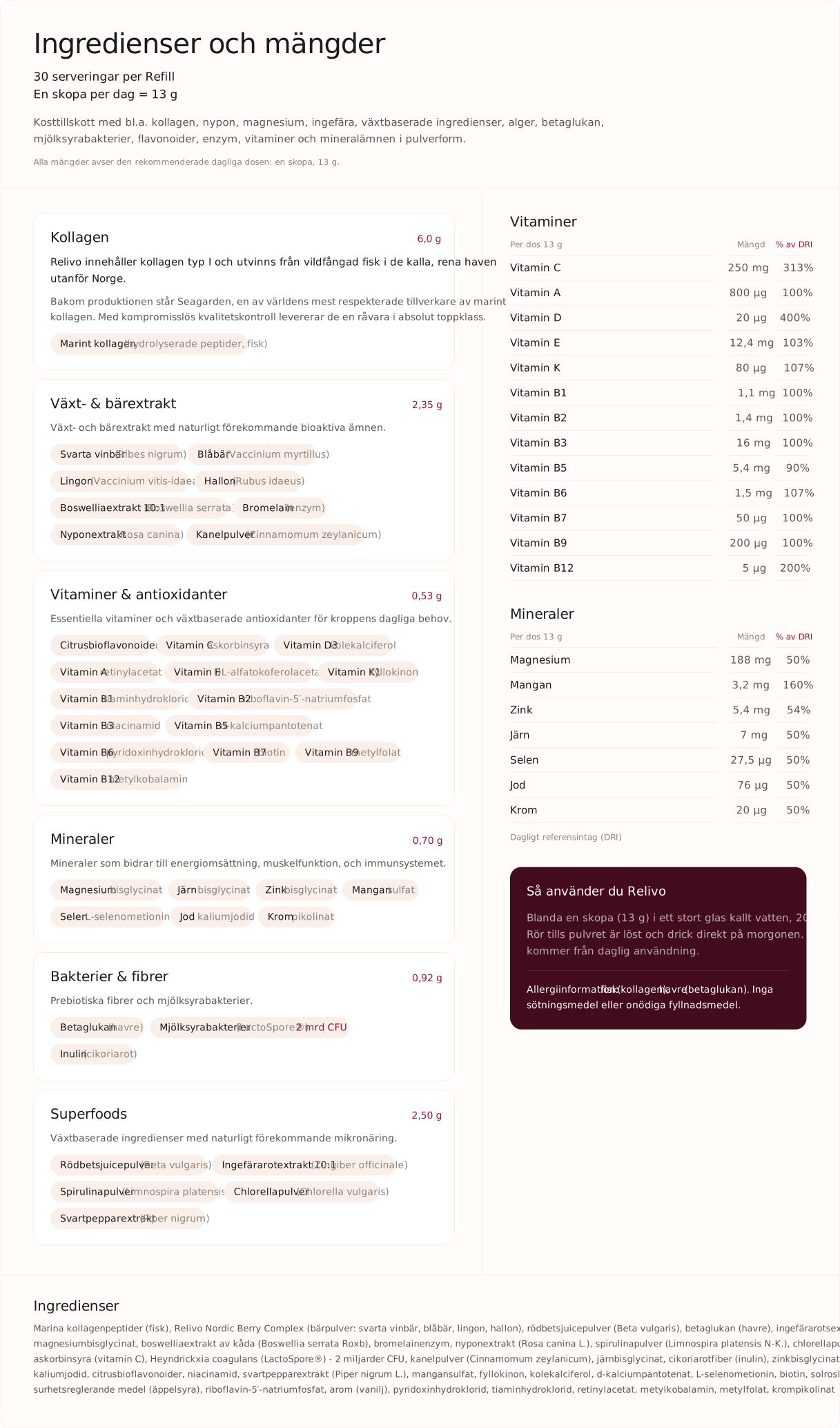
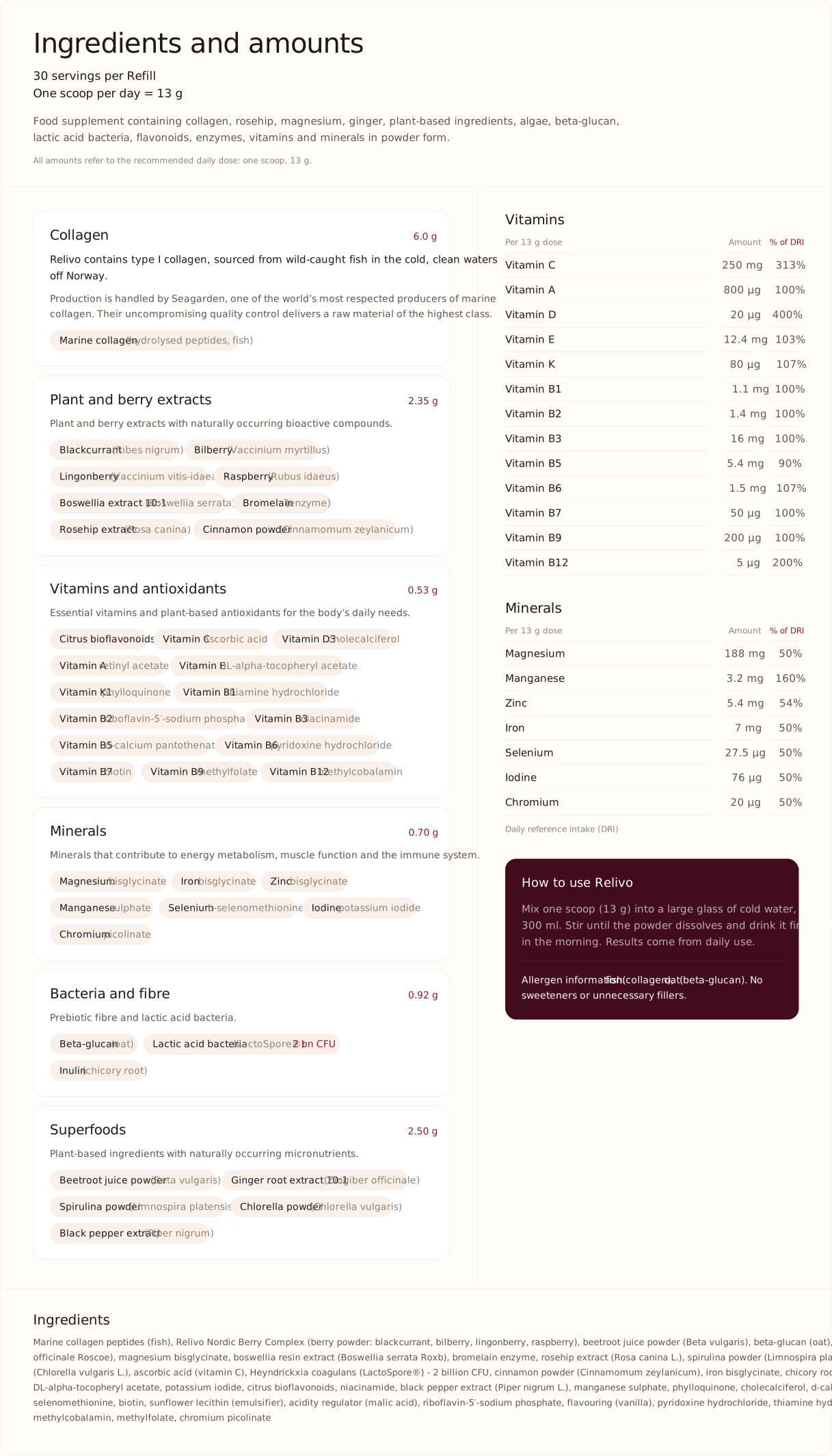
Relivo is a complete daily nutritional supplement developed in collaboration with Swedish researchers and nutritional physiologists. Relivo combines 38 carefully selected nutrients that support the body's most important systems and structures.
Everything is gathered in one scoop of powder, developed to be simple to use and easy to incorporate into your daily routine. Relivo mixes in 60 seconds and serves as a long-term nutritional foundation for energy, immune function, gut health, muscles, and joints.
Sources
- Pontzer H et al: Daily energy expenditure through the human life course (Science, 2021)
- Cruz-Jentoft AJ et al: Sarcopenia: revised European consensus on definition and diagnosis (Age and Ageing)
- Riggs BL et al: Population-based study of age and sex differences in bone volumetric density (Journal of Bone and Mineral Research)
- Allen LH: How common is vitamin B-12 deficiency? (American Journal of Clinical Nutrition)
- Holick MF: Vitamin D deficiency (New England Journal of Medicine)
- Franceschi C, Campisi J: Chronic inflammation (inflammaging) and its potential contribution to age-associated diseases (Journals of Gerontology)
- Fiatarone MA et al: Exercise training and nutritional supplementation for physical frailty in very elderly people (New England Journal of Medicine)
- Bauer J et al: Evidence-based recommendations for optimal dietary protein intake in older people (PROT-AGE)
- Stern Y: Cognitive reserve (Neuropsychologia)
- Swedish Food Agency: Dietary advice for those over 65