Methylfolate or folic acid? Why the form matters
Folate, folic acid, and methylfolate refer to three different things that are often confused. Here is the difference and what it means in practice.

Introduction
On ingredient labels, three words appear that many use as synonyms: folate, folic acid, and methylfolate.
They are not the same thing. The difference lies in how many steps the body needs to take before the substance can be used, and for a significant portion of the population, those steps can be more difficult than you might think.
At the same time, folic acid is one of the most successful public health tools ever introduced, resulting in tens of thousands of prevented birth defects. It is therefore not a simple story of one good and one bad option.
In this guide, we go through what the three terms mean, how the conversion works, what the MTHFR gene has to do with it, and who actually stands to gain from one form over the other.
Three terms that are often confused
Let’s clear up the terminology first.
Folate is the collective name for the entire vitamin B9 family and is often used specifically for the naturally occurring forms found in food. Leafy green vegetables, legumes, liver, and citrus fruits are rich sources. The word comes from the Latin folium, meaning leaf.
Folic acid is a synthetic form that does not occur naturally in food in any significant amount. It was developed in the 1940s, is stable and inexpensive to produce, and is used in the vast majority of supplements and fortified foods.
Methylfolate, or 5-MTHF, is the form the body actually uses. It is the end product in the conversion chain and the form that circulates in the blood and passes into the cells.
In other words: regardless of which form you ingest, the body ultimately needs methylfolate. The question is how many steps it takes to get there.
What folate does in the body
Before we get into the differences, it is worth understanding why it matters.
Folate is central to what is known as one-carbon metabolism, a set of biochemical processes where methyl groups are moved between molecules. It sounds abstract but has very concrete consequences.
Folate is needed for, among other things:
- Synthesis of DNA and RNA, i.e., all cell division
- Conversion of homocysteine to methionine
- Formation of neurotransmitters in the brain
- Normal blood formation
- Early fetal development
According to EU-approved health claims, folate contributes to normal blood formation, normal homocysteine metabolism, normal psychological function, normal immune system function, the reduction of tiredness and fatigue, and normal cell division.
The conversion chain
This is the core of the entire issue.
Folic acid cannot be used as is. It must first be converted through several steps:
First, folic acid is reduced to dihydrofolate, then to tetrahydrofolate. Both of these steps are handled by the same enzyme, dihydrofolate reductase, often abbreviated as DHFR.
This is followed by further steps leading to the final product, 5-MTHF, where the final step is catalyzed by the enzyme methylenetetrahydrofolate reductase. This is the enzyme abbreviated as MTHFR.
Natural folate from food takes a slightly different path but also needs to be processed.
Methylfolate in supplement form skips the entire chain. It is already the final product.
The MTHFR gene
The gene that codes for the MTHFR enzyme exists in different variants, and two of them are common enough to be significant at a population level.
The most studied is called C677T. Individuals who carry two copies of the variant, meaning they are homozygous, have an enzyme activity that is approximately 70 percent lower than normal. Those who carry one copy have about 35 percent lower activity.
Prevalence varies between population groups. Among Europeans, an estimated 10 to 15 percent are homozygous, and a significantly larger proportion carry at least one copy.
This means that a substantial part of the population has a reduced ability to convert folate into its active form. For them, there is a reasonable theoretical argument for taking methylfolate directly.
A caveat is needed here, however. Having an MTHFR variant does not automatically mean that you have a folate deficiency or symptoms. The body has compensatory mechanisms, and most people with the variant feel perfectly fine.
The bottleneck few know about
In addition to MTHFR, there is another limitation that has received less attention.
Research has shown that the activity of DHFR, the enzyme that performs the first conversion steps of folic acid, is surprisingly low in the human liver. Furthermore, it varies greatly between individuals, in some studies by up to fivefold differences.
The consequence is that the body has a limited capacity to convert folic acid, especially at higher doses. What is not converted in time remains circulating in the blood in its unchanged form.
Unmetabolized folic acid
This phenomenon is known as unmetabolized folic acid, often abbreviated as UMFA.
It is found in the blood of a large proportion of the population in countries with widespread food fortification, and the concentration increases with the dosage.
Research into what this means is still ongoing. Questions being raised include whether high levels can affect certain immune functions and whether it can mask signs of B12 deficiency.
It is important to note that this is not yet settled. While some observations have raised questions, there is not enough evidence to draw firm conclusions about health risks at normal intake levels.
For those who wish to avoid this issue entirely, methylfolate is an alternative, as it does not result in unmetabolized folic acid.
What folic acid has achieved
It is important to keep things in perspective here.
Folic acid is one of the most successful public health interventions ever implemented.
Two major studies in the early nineties showed that folic acid supplementation before and during early pregnancy significantly reduced the risk of neural tube defects, which are serious malformations of the brain and spinal cord. The effect was so clear that one of the studies was terminated early for ethical reasons.
This led to recommendations and the fortification of food in a long list of countries, and the incidence of neural tube defects has decreased significantly since then.
All of that evidence is based on folic acid, not methylfolate. This is a crucial distinction when it comes to recommendations during pregnancy.
Pregnancy: current guidelines
Official recommendations in Sweden and internationally specify folic acid for those planning a pregnancy and during the first trimester, at a dose of 400 micrograms per day.
The reason for this is precisely that the evidence base is built on folic acid. Methylfolate has theoretical advantages but lacks equivalent, extensive documentation for this specific purpose.
This does not mean that methylfolate is unsuitable. However, it does mean that those who are pregnant or planning a pregnancy should follow medical recommendations and discuss any deviations with a midwife or doctor, rather than making decisions on their own based on information found online.
The B12 connection
A detail that is important to understand.
Folate and B12 work closely together in the methylation cycle. A B12 deficiency causes blood formation disorders that resemble those caused by folate deficiency.
High doses of folate can correct the blood count without addressing the underlying B12 deficiency. The nerve damage that B12 deficiency can cause may then continue to progress while the most obvious warning sign has disappeared.
This is one of the reasons why folate and B12 are often combined in supplements, and why bioactive forms of both are used in more well-considered formulations.
Riboflavin and MTHFR
A lesser-known but elegant detail.
The MTHFR enzyme requires a cofactor to function, and that cofactor is based on riboflavin, also known as vitamin B2.
Research has shown that riboflavin status affects how well MTHFR functions, and that the effect is particularly clear in individuals with the C677T variant. In studies, riboflavin supplementation has improved markers in this specific group.
This means that B2 is part of the same system, and that a formulation which takes this into account is more well-considered than one that simply replaces folic acid with methylfolate.
Who has the most to gain from methylfolate?
In summary, research suggests that the following groups have the strongest case:
Individuals with a known MTHFR variant. If you have been tested and know that you carry the C677T variant in homozygous form, there is a reasonable biochemical rationale.
Individuals with elevated homocysteine. A blood value that may indicate that methylation is not functioning optimally.
Individuals taking higher doses. The higher the dose of folic acid, the greater the proportion that risks remaining unmetabolized.
Individuals who want to avoid the issue. Methylfolate makes it irrelevant.
For most healthy individuals who get folate from food and moderate doses from supplements, both forms work well. The difference is theoretically interesting but practically small.
When should you seek medical care?
Discuss the folate issue with your healthcare provider if you:
- Are planning a pregnancy or are pregnant
- Have confirmed elevated homocysteine
- Have anemia of unknown cause
- Take medications that affect folate metabolism, such as methotrexate or certain epilepsy medications
- Have an intestinal disease that affects nutrient absorption
Routine testing for MTHFR variants is not recommended in Sweden, as the results rarely change the management for an otherwise healthy person. Read more at 1177 Vårdguiden.
Summary
Folate is the collective term, folic acid is the synthetic form, and methylfolate is the form the body actually uses.
Folic acid must be converted in several steps, and both MTHFR gene variants and the limited capacity of the DHFR enzyme can make the process slower for some. Methylfolate skips this chain.
At the same time, the entire evidence base for the role of folic acid in preventing neural tube defects is based on folic acid itself, which is why recommendations during pregnancy continue to be based on that form.
For most healthy people, both forms work well. Those with a known MTHFR variant, elevated homocysteine, or who simply want to avoid the conversion issue have a reasonable reason to choose methylfolate.
And regardless of which form you choose, the interaction with B12 and B2 is at least as important as the folate itself.
About Relivo
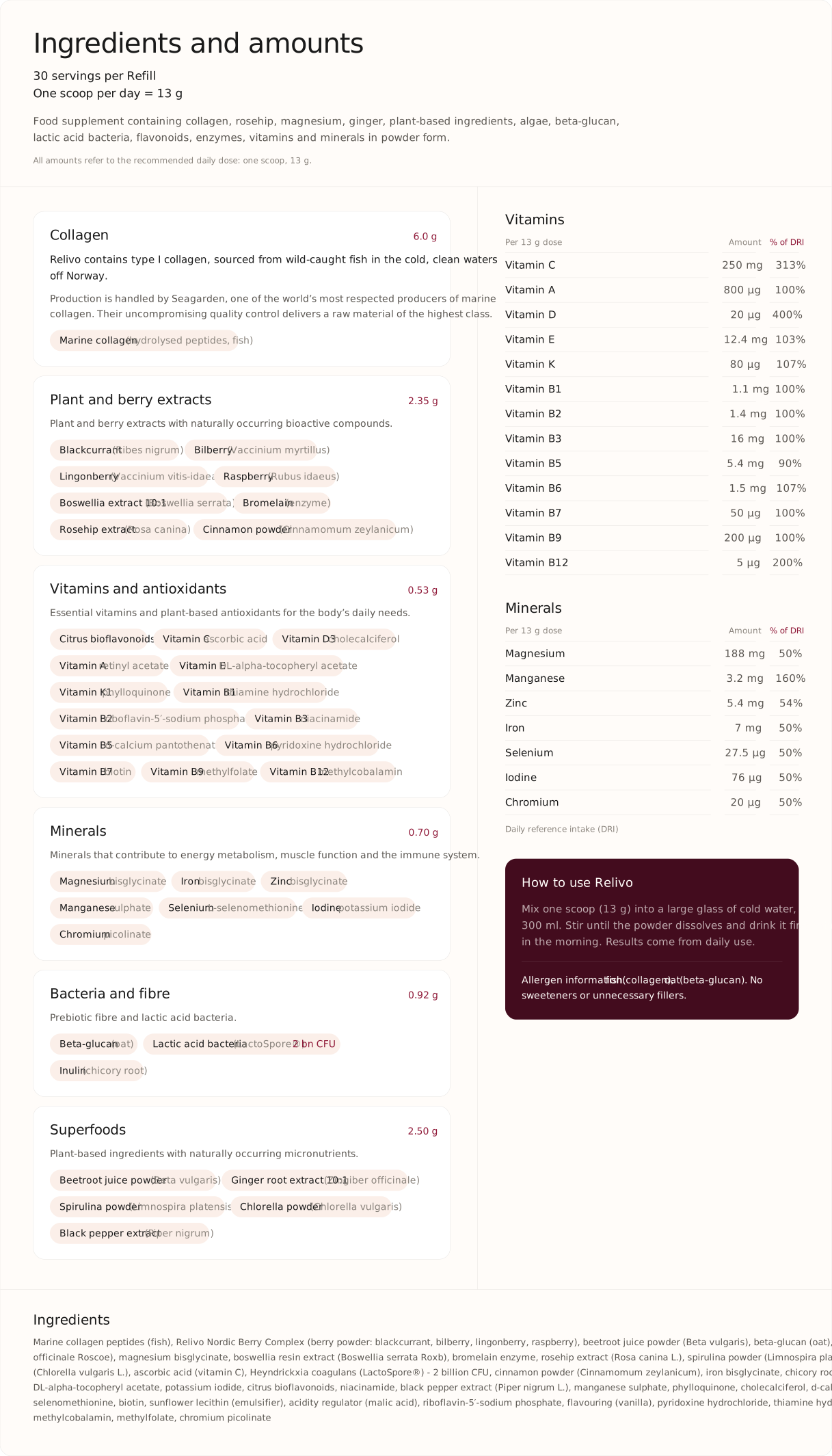
Relivo is a complete daily nutritional supplement developed in collaboration with Swedish researchers and nutritional physiologists. Relivo combines 38 carefully selected nutrients that support the body's most important systems and structures.
Everything is gathered in one scoop of powder, developed to be simple to use and easy to incorporate into your daily routine. Relivo mixes in 60 seconds and serves as a long-term nutritional foundation for energy, immune function, gut health, muscles, and joints.
Sources
- Scaglione F, Panzavolta G: Folate, folic acid and 5-methyltetrahydrofolate are not the same thing (Xenobiotica, 2014)
- Bailey SW, Ayling JE: The extremely slow and variable activity of dihydrofolate reductase in human liver (PNAS, 2009)
- Pietrzik K et al: Folic acid and L-5-methyltetrahydrofolate: comparison of clinical pharmacokinetics and pharmacodynamics (Clinical Pharmacokinetics)
- MRC Vitamin Study Research Group: Prevention of neural tube defects (The Lancet, 1991)
- Czeizel AE, Dudas I: Prevention of the first occurrence of neural-tube defects by periconceptional vitamin supplementation (New England Journal of Medicine, 1992)
- Frosst P et al: A candidate genetic risk factor for vascular disease: a common mutation in methylenetetrahydrofolate reductase (Nature Genetics, 1995)
- Liew SC, Gupta ED: Methylenetetrahydrofolate reductase (MTHFR) C677T polymorphism: epidemiology, metabolism and the associated diseases (European Journal of Medical Genetics)
- McNulty H et al: Riboflavin lowers homocysteine in individuals homozygous for the MTHFR 677C to T polymorphism (Circulation)
- Obeid R et al: Is 5-methyltetrahydrofolate an alternative to folic acid for the prevention of neural tube defects? (Journal of Perinatal Medicine)
- Swedish Food Agency: Folate