What happens to the body at 40?
Forty is the decade when changes become noticeable in everyday life. Here is what is actually happening, and what you can still influence.

Introduction
At thirty, changes happen quietly. At forty, they start to make themselves known.
The reading glasses you suddenly need. The recovery that takes an extra day. The sleep that is no longer as deep. The weight that creeps up even though nothing obvious has changed.
It is also the decade when the habits built—or not built—over twenty years begin to show their results. This is why forty is often described as a turning point, not because the body suddenly changes, but because the effects become visible.
In this guide, we go through what is actually happening, which changes are inevitable, and which ones you can influence more than most people think.
Vision changes, and it is the first thing most people notice
Around the age of 40 to 45, most people start to notice that it becomes harder to focus on things up close.
The phenomenon is called presbyopia and is due to the eye's lens gradually losing its elasticity. The lens can no longer change shape as effectively, which causes near vision to deteriorate.
It is one of the most predictable age-related changes there is. Practically everyone is affected, regardless of lifestyle, and it cannot be trained away.
For many, it is the first concrete signal that the body is changing.
Muscle mass decreases faster
The gradual muscle loss that began at thirty accelerates during your forties.
Without strength training, most people lose somewhere between three and eight percent of their muscle mass per decade from age forty, and the rate increases thereafter.
What makes this more important than it sounds is that muscle mass is not just about strength. Muscle tissue is metabolically active; it affects insulin sensitivity, protects joints, and is strongly linked to functional ability later in life.
The good news remains: strength training works just as well at forty as it does at twenty. Adaptation happens slightly more slowly, but it still happens.
Collagen becomes visible
By forty, the body's collagen production has been declining for fifteen years.
The effect becomes noticeable. The skin recovers more slowly, elasticity decreases, and the fine lines you had at thirty become more pronounced.
But it is not just about appearance. The same process affects tendons, ligaments, and cartilage. Many discover at forty that the body needs a longer warm-up, that tendons become irritated more easily, and that it takes longer to recover from overuse injuries.
This is also the reason why many change their form of exercise at this age, moving from high-impact activities to more gentle alternatives.
Sleep becomes shallower
The proportion of deep sleep has been decreasing continuously since your twenties, and by forty, the difference is clear.
Many notice that they wake up more often during the night, that they don't feel as rested after the same number of hours, and that a late night takes more of a toll than it used to.
Sleep is therefore changing not just in quantity, but in structure. This, in turn, affects recovery, hormonal balance, and cognitive function the following day.
Hormonal shifts begin
For women perimenopause can begin in your forties. The average age for menopause in Sweden is around 51, but the preceding transition period can start eight to ten years earlier.
Symptoms during perimenopause are often vague: irregular periods, sleep disturbances, mood swings, and changes in energy levels. It is precisely this vagueness that leads many to not connect them to hormonal changes.
For men testosterone continues to drop by about one to two percent per year. By forty, levels have typically decreased noticeably from their peak in your twenties, which can affect muscle mass, energy, recovery, and libido.
Metabolism, once again
Here, it is worth repeating what research has shown.
The major study published in Science in 2021, which analyzed energy expenditure in over 6,400 people, found that metabolism is stable from approximately age twenty to age sixty.
Weight gain at forty is therefore rarely due to a decrease in calorie burning. More common explanations are reduced muscle mass, less spontaneous movement in daily life, changed eating habits, poorer sleep, and increased stress.
This is an important distinction because all these factors can be influenced, whereas an unstoppable metabolic decline would be beyond your control.
Blood vessels gradually stiffen
The elasticity of the arteries decreases with age, a process known as arterial stiffness.
Blood vessels become less compliant, which contributes to the fact that blood pressure tends to rise over the years. At forty, this change is underway but rarely causes symptoms.
This is one of the reasons why regular blood pressure checks become more relevant from forty onwards. High blood pressure rarely causes symptoms until it has been present for a long time.
Cognitively: two things happen at once
The perception of cognition at forty is more nuanced than it is usually portrayed.
Processing speed gradually declines. It takes slightly longer to find the right words, switch between tasks, and solve new problems under time pressure.
Crystallized intelligence continues to increase at the same time. Knowledge, experience, pattern recognition, and judgment improve throughout your forties and often long after.
The net effect is that most people perform better in their profession at forty-five than at thirty, even though certain measurable sub-functions have declined.
What matters most now
Your forties are a great time to move from chance to strategy.
1. Strength training becomes non-negotiable. Two to three sessions a week counteract the single most important age-related change.
2. Actively prioritize sleep. It won't improve on its own, and the effects of poor sleep become more apparent.
3. Check your blood pressure regularly. Simple, inexpensive, and one of the most valuable measurements available.
4. Increase your protein intake. Your needs increase with age, while your appetite often decreases.
5. Build mobility and balance into your routine. What is neglected now will be harder to regain later.
6. Take hormonal changes seriously. Both women and men now have access to testing and treatment that were not available before.
Nutrition in your forties
Some nutrients become more relevant during this decade.
Protein to counteract muscle loss. For those who exercise, the need is often higher than the official minimum levels.
Vitamin D which becomes more important as the skin's production capacity decreases.
Magnesium for muscle and nervous system function, and one of the nutrients that is often low in Nordic intake studies.
Iron for women, where heavy bleeding during perimenopause can increase losses.
B vitamins for normal energy metabolism.
Collagen as a building block for connective tissue, as the body's own production declines.
When should you seek medical care?
Book an appointment if you have:
- Persistent fatigue that does not improve with sleep
- Changed menstrual patterns or suspected perimenopause
- Reduced libido, energy, or motivation over a longer period
- Blood pressure you haven't checked in the last few years
- Changes in vision or hearing
- New pain conditions that do not go away
Forty is a reasonable age for a more comprehensive health check-up, including blood pressure, blood lipids, blood sugar, and relevant blood values. Read more at 1177 Vårdguiden.
Summary
At forty, the changes that began earlier become noticeable in everyday life. Presbyopia, faster muscle loss, decreased collagen production, shallower sleep, and the onset of hormonal shifts are all common.
At the same time, experience, judgment, and knowledge continue to grow, which for most people means that their overall capacity is higher than ever.
Metabolism is still not slowing down. What changes are muscle mass, movement patterns, and habits, and all three can be influenced.
The forties are therefore not the decade when the body starts to fail. It is the decade when it becomes clear what you have invested in, and there is still plenty of time to change direction.
About Relivo
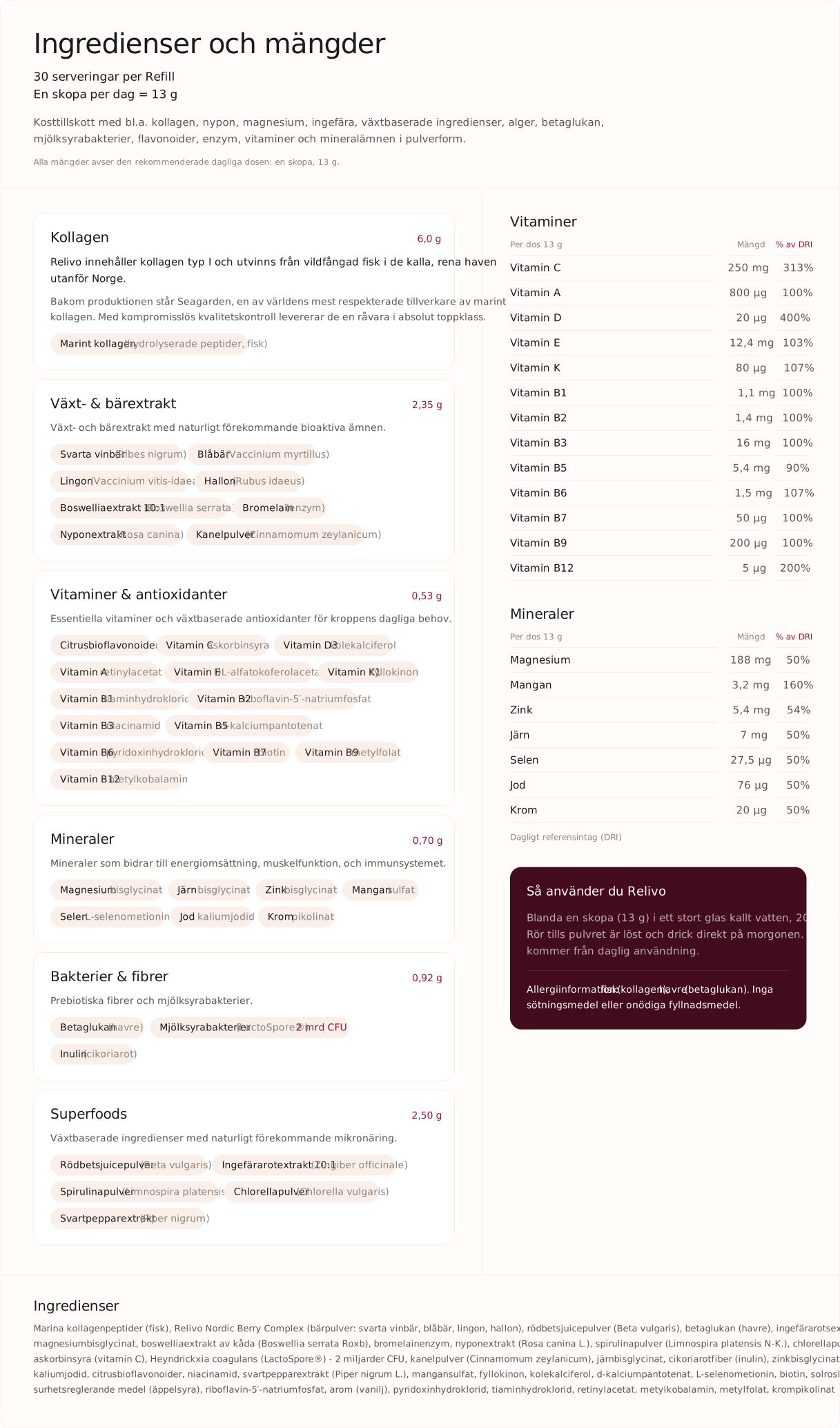
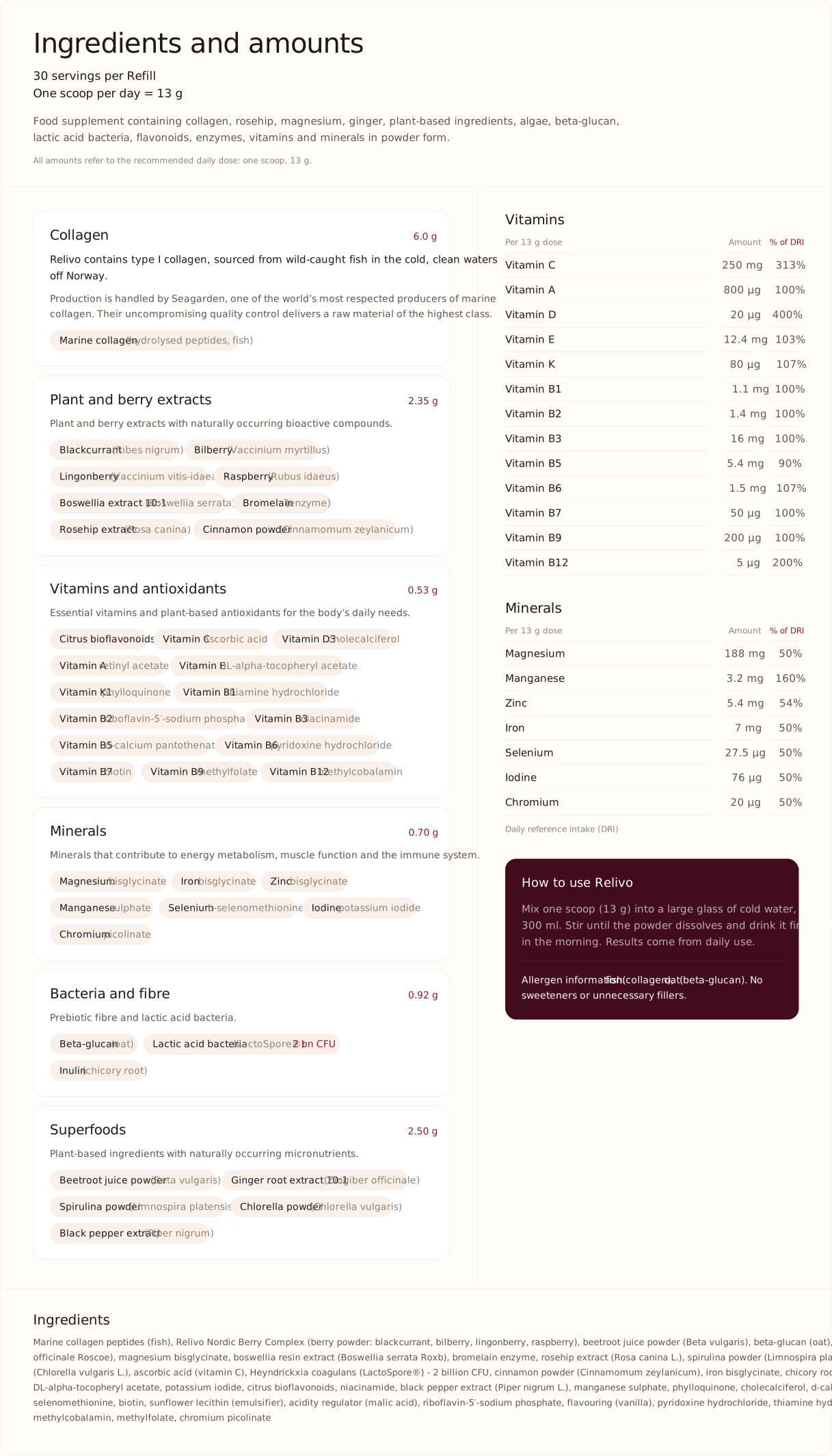
Relivo is a complete daily nutritional supplement developed in collaboration with Swedish researchers and nutritional physiologists. Relivo combines 38 carefully selected nutrients that support the body's most important systems and structures.
Everything is gathered in one scoop of powder, developed to be simple to use and easy to incorporate into your daily routine. Relivo mixes in 60 seconds and serves as a long-term nutritional foundation for energy, immune function, gut health, muscles, and joints.
Sources
- Pontzer H et al: Daily energy expenditure through the human life course (Science, 2021)
- Cruz-Jentoft AJ et al: Sarcopenia: revised European consensus on definition and diagnosis (Age and Ageing)
- Charman WN: The eye in focus: accommodation and presbyopia (Clinical and Experimental Optometry)
- Ohayon MM et al: Meta-analysis of quantitative sleep parameters from childhood to old age (Sleep)
- Santoro N: Perimenopause: From Research to Practice (Journal of Women's Health, 2016)
- Mitchell GF et al: Arterial stiffness and cardiovascular events (Circulation)
- Salthouse TA: When does age-related cognitive decline begin? (Neurobiology of Aging)
- Bauer J et al: Evidence-based recommendations for optimal dietary protein intake in older people (PROT-AGE)