What are amino acids - the body's 20 building blocks explained
Every protein in your body is built from just 20 small molecules. Here, we explain what amino acids are and the role each group plays in the body.
Introduction
We talk about protein often, but it is the amino acids that do the heavy lifting. These are the tiny building blocks that the body combines to create almost everything: muscles, enzymes, hormones, and parts of the immune system.
Despite being so central, amino acids are rarely a staple of health conversations. Once you understand them, it becomes easier to see why protein, collagen, and nutritional quality are all connected.
In this article, we go through what amino acids are, why there are exactly 20 of them in the body, and what they do. We’ll keep it simple and practical.
What exactly are amino acids?
Amino acids are small molecules that act as building blocks for protein. When you eat protein, it is broken down into individual amino acids, which the body then reassembles into new proteins.
It’s a bit like a big bag of LEGO bricks. The same 20 pieces can be used to build an infinite number of different structures.
In the human body, there are 20 standard amino acids used to build protein. These are the ones we cover here.
The 20 amino acids - a brief overview
To understand their role, you need to know that amino acids are divided into three groups. This classification is based on where the body gets them from.
The difference isn't that some are "more important" than others. It’s about which ones the body can produce itself and which ones must come from food.
Essential amino acids - come from food
Nine of the amino acids are essential, meaning the body cannot produce them on its own. They must come from what you eat.
These are: histidine, isoleucine, leucine, lysine, methionine, phenylalanine, threonine, tryptophan, and valine. Three of them—leucine, isoleucine, and valine—are also known as BCAAs and are well-known in fitness circles.
If any of the essential amino acids are missing, protein synthesis falters. This is why the quality of protein in your diet, not just the quantity, matters.
Non-essential amino acids - built in the body
The body can produce eleven of the amino acids itself. They are called non-essential, which can easily sound like they are less important.
These include alanine, asparagine, glutamic acid, and serine. The name is misleading—the body needs them just as much; it’s just capable of building them on its own.
It’s a good example of how nutritional terminology can sometimes be misleading. Everything is needed, all the time.
Conditionally essential - sometimes from food, sometimes not
Between the two groups lies an intermediate category. Six amino acids are considered conditionally essential: arginine, cysteine, glutamine, glycine, proline, and tyrosine.
Usually, the body can produce these itself. However, during periods of rapid growth, high stress, or other physical demands, the need may increase, making it necessary to obtain them through food as well.
This is the group that often appears in collagen supplements and recovery products. Glycine and proline are two of the most well-known examples.
What amino acids do in the body
The most well-known function of amino acids is building muscle. But that is only a small part of their role.
They are the raw materials for enzymes that drive the body's chemistry, for hormones that regulate metabolism, and for antibodies in the immune system. Skin, hair, and nails are also largely composed of protein—and therefore of amino acids.
Some amino acids also have more specific roles. Tryptophan, for example, is the precursor to serotonin, a neurotransmitter in the brain, and glycine is a key component of connective tissue and collagen.
Leucine plays a special role in muscle protein synthesis and is frequently highlighted in research on exercise and aging. Glutamine is the most abundant amino acid in the blood and plays a role in both gut health and immune cells.
This is a good example of how the 20 amino acids are not interchangeable. Each has its own niche in the body's chemistry, even though they work closely together.
Where to find amino acids in food
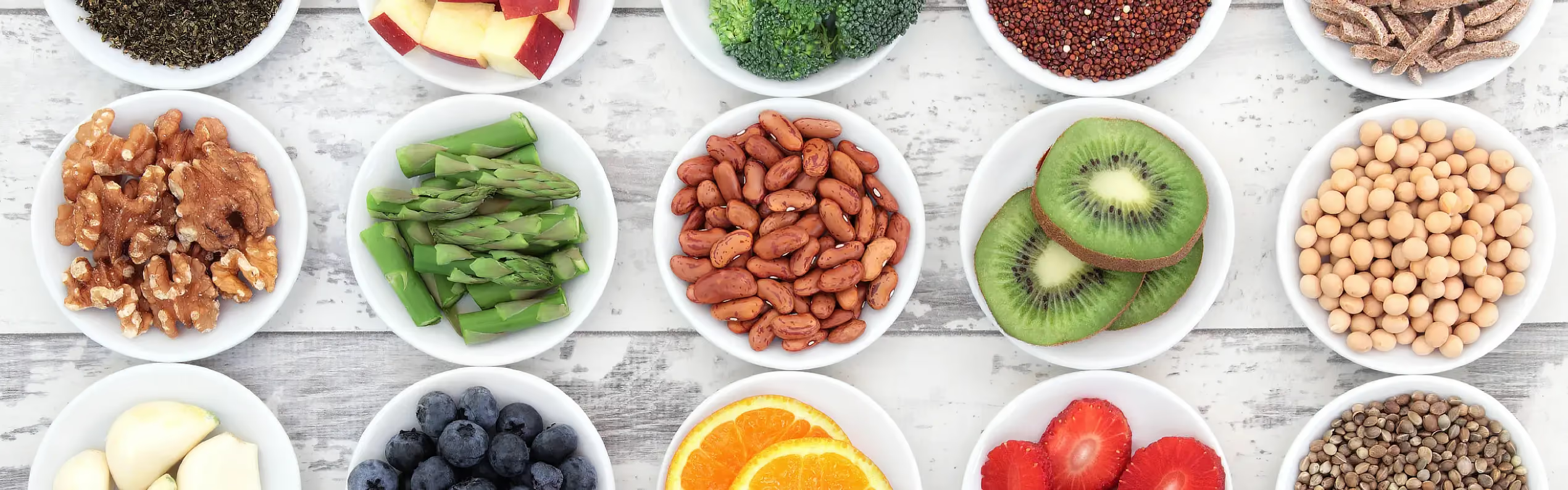
The easiest way to get a wide range of amino acids is to eat protein-rich foods. Eggs, meat, fish, dairy, and legumes are classic sources.
Animal protein sources often contain all nine essential amino acids in good amounts. This is known as a "complete protein."
Plant-based sources have different strengths and weaknesses. By combining them, for example legumes with whole grains, you get a variety that covers the entire spectrum.
The amount you need depends on age, activity level, and life situation. The Swedish Food Agency suggests a baseline of roughly 0.8 grams of protein per kilogram of body weight per day, with higher requirements for those who exercise heavily.
Who needs to pay extra attention to amino acids?
For most people, a varied diet goes a long way. However, there are some groups for whom it is worth paying a little extra attention.
Those who exercise a lot, are older, or eat a strictly plant-based diet are generally more at risk of missing out on something. The same applies during periods of illness or recovery.
This is where protein quality and variety become especially relevant. It is not necessarily about more protein automatically, but about the right composition throughout the day.
A simple tip is to distribute protein evenly across several meals instead of consuming it all in one large dinner. The body can simply utilize the building blocks better when they arrive in moderate portions.
Amino acids in collagen and Relivo
Collagen is a particularly interesting protein because it contains unusually high amounts of glycine, proline, and hydroxyproline. These are the amino acids that give collagen its structure and properties.
Relivo's collagen is a source of exactly those amino acids. Together with the other ingredients in the formula, it contributes to a broad foundation of building blocks.
Let’s be honest: amino acids themselves are not miracle substances. They are the raw materials the body needs to build its own proteins, which is why variety and consistency are what matter.
If you want to read more about how nutrients work together, you can take a look at our article on nutrient absorption, or read more about our work at relivo.se.
Summary
Amino acids are the 20 building blocks that make up all the protein in the body. Nine are essential and must come from food, eleven can be produced by the body itself, and six are conditionally essential depending on your life situation.
They build muscles, enzymes, hormones, skin, and parts of the immune system. The simplest path to broad coverage is a varied diet with different protein sources.
The next time you think about amino acids, think of them as Lego bricks, not miracles. It is the combination that builds the body, from muscle cells to the outermost layer of the skin.
About Relivo
Relivo is a complete daily nutritional supplement developed in collaboration with Swedish researchers and nutritionists. Relivo combines 38 carefully selected nutrients that support the body's most important systems and structures.
Everything is contained in one scoop of powder, developed to be easy to use and simple to incorporate into your daily routine. Relivo mixes in 60 seconds and serves as a long-term nutritional foundation for energy, immune health, gut health, muscles, and joints.
Sources